Wednesday, October 07, 2015

Alaska Summer 2015

alt text
Alaska, like the rest of the West, has been experiencing a drought in recent years.  One does not normally put Alaska and drought in the same sentence.  With this in mind, the cruise this summer focused on the effects of current changes in weather patterns.

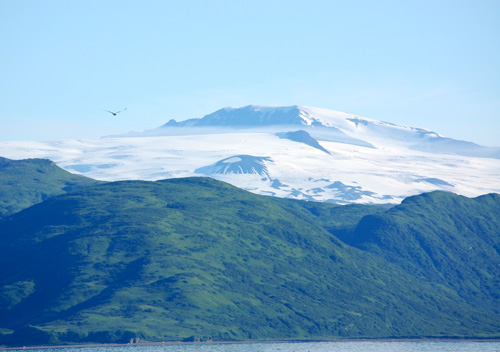
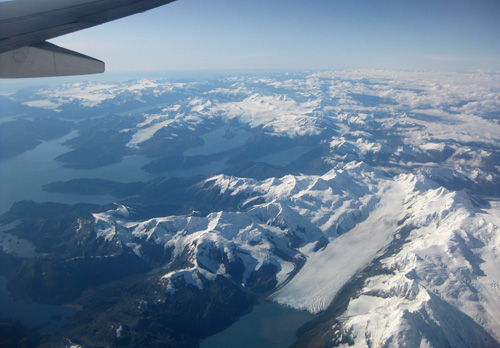
One of the obvious signs this season was the decrease in snow pack.  Normally by mid-May the snow level is fairly close to the shoreline and in some cases still very heavy.  Last year, and even more so this year, the snow level mid-May was more like what one would expect in August.  The town of Valdez, not far from Cordova, recorded six feet less snowfall than the previous record low.  The city of Anchorage, Alaska's largest, experienced the least snowfall since records have been kept. By the time Mark arrived in Cordova in March to begin his late winter solo cruise, the snow line was 800 to 1,000 feet above sea level.

alt text
Most towns in Alaska, like many in Washington State, depend on steady melt of snow pack and lakes for their water supply, not enormous dams.  Last year the seafood processing plant in King Cove on the Alaska Peninsula, the largest such facility in the world as measured by product output, was forced to curtail production due to insufficient water.  The town of Cordova relies on snow melt to drive the hydro-electric power plant, and this year’s insufficient water flow would force consumption of expensive diesel fuel throughout the summer fish processing season, the largest such production in history.

alt text
Alaska forest fires have been occurring earlier and over a longer season the last couple of years.  Fires in the interior of Alaska are especially destructive in that they burn the protective tundra layer over the permafrost, causing melting and the release of methane gases into the atmosphere. By early August, more acres had been consumed by fire than any previous season but one.  It was expected that the previous record would be broken by the end of summer.

alt text
Sea water temperature is critical to salmon spawning and a rise of only a few degrees can bring havoc  to the  fisheries.  Another effect of warmer temperatures can be an unusually high rate of growth of toxic phytoplankton. The death of an unusual number of sea birds in the Aleutians, as well as ten fin whales found dead off Kodiak Island, was provisionally attributed to this phenomenon.

alt text
We were fortunate, however, to note an extraordinary abundance of Humpbacks this season, particularly near the Kodiak and Shumagin Islands.  On several occasions one or more whales breached completely clear of the water very close to TAMARA.  Unfortunately, none ever gave adequate warning for Nancy to be able to aim and focus her camera.  She's still hoping for that great whale shot!

alt text
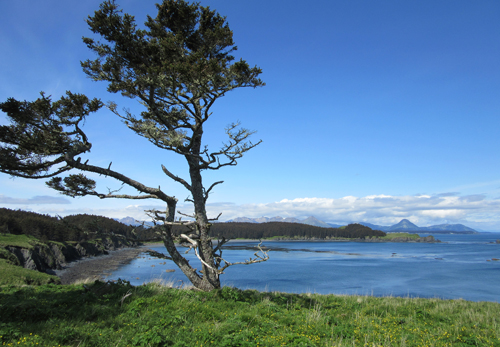
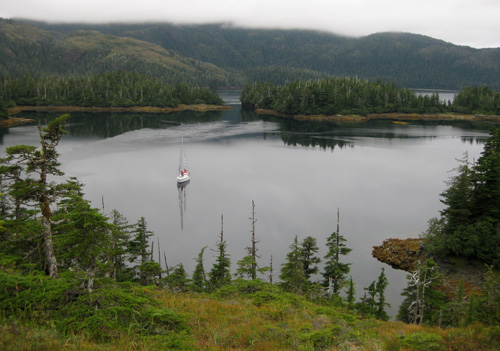
Having made the cruise to the west several times before, we would be breaking little new ground.  Instead we planned to revisit several of our favorite anchorages in the southwest part of Prince William Sound, the Kenai Peninsula, the Kodiak archipelago, the rugged Alaskan Peninsula, the Shumagin and Konuij Islands.  However, this season we ventured a bit off the track on this route to visit the small but important fishing of Chignik on the Alaskan Peninsula.

alt text
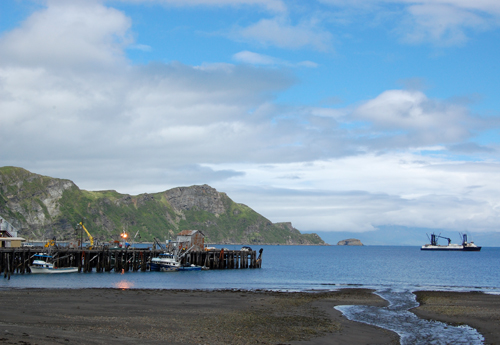
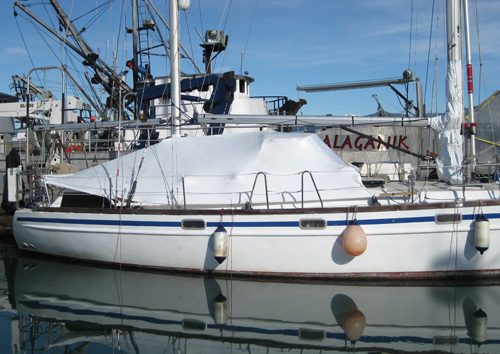
Chignik, the Aleutik word for “Big Wind” is sited at the approaches to a large, but very shallow, lagoon that produces a important Red Salmon run.  The village’s name was exceptionally well chosen, and during much of our time in the brand new, well constructed harbor the place lived up to its windy reputation.

The salmon seine fishing boats that work the Chignik red salmon fishery are generally of very shallow draft, permitting them to work in the lagoon when necessary.

alt text
On our return to Cordova, TAMARA’s home-port, we were pleased to see secured to the transient dock a boat and crew we’d come to know in Patagonia and Antarctica.  SAUVAGE, with Sophie and Didier aboard, was soon to depart for Mexico.  But we were able to spend a few days together, and extensive discussions involving their decision whether to rebuild or replace their main engine hopefully allowed Sophie and Didier to come to a good resolution!  Their latest phone call, from Ketchikan, had them planning to make their best time to Bellingham, WA to take possession of a new engine, which given the extraordinary distances they cover each season will see extensive use.

alt text
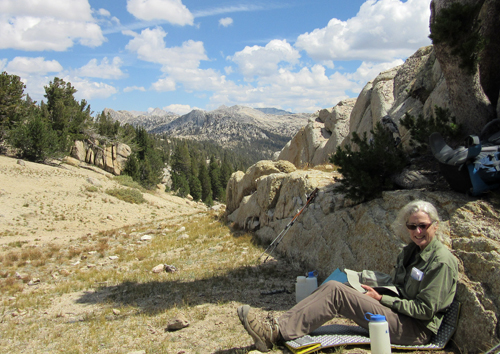
Nancy departed in mid-August to continue her hike of the Pacific Crest Trail.  She would hike from Tuolumne Meadows to Donner Pass, making her total completed miles more than half way.   The main concern on this hike was the fire danger but the only sign of fire was a day or two of very light smoke which she felt was very fortunate.  Mark made yet another drive home, having now completed the spectacular 2,250 mile drive from Alaska through the Yukon and British Columbia more than two dozen times.  For him, it's the best way to make the transition back to the bustle of life in the Puget Sound region.

alt text

Labels: , , , , ,

Tuesday, June 05, 2012

Winter Cruise in Prince William Sound

Early in my career as a fisherman, I'd made a week-long passage from Cape Newenham, on the Bering Sea coast, to Cordova in Prince William Sound. It was early spring, just after the sea-ice had finally gone out for the year. Along the way, the volcanic peaks and rugged glaciers of the Alaska Peninsula made me wonder what it would be like to take a boat deep into those fjords and ski the remote slopes. More years of experience taught me, however, that there were really no secure anchorages in that region that would offer adequate protection for a boat while off skiing.
Alternate Text
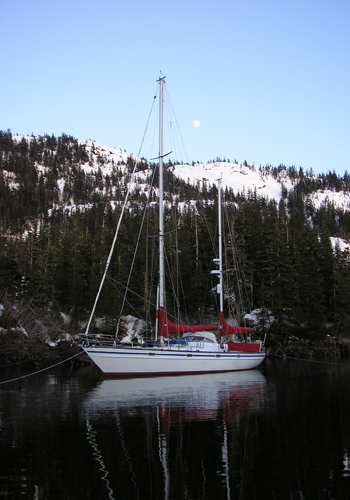
But Prince William Sound was another world altogether. The sound is replete with small, well protected anchorages, many of which afford opportunity to run lines ashore to securely moor a boat. This would be essential, as the mountains and glaciers of the region generate severe, sometimes violent, katabatic winds. It just wouldn't do to be up skiing and have a williwaw blow the yacht aground, or out to sea.

The challenge would be to find secure anchorages that were not frozen over, and this was not always easy or even predictable. Although the sound lies mostly between 60 degrees and 61 degrees north latitude, small bays and sheltered anchorages here generally freeze not solely as a result of extreme cold, but more often due to the quantity of fresh water that flows out atop the seawater. That freshwater varies from season to season and from place to place. Short of chartering an airplane, the only real way to find out would be to go and have a look.

Summer brings hundreds of vessels engaged in one way or another in the salmon fishery, along with cruise ships and more pleasure boats each season. In the winter there is essentially no traffic at all in the sound, save for an occasional tug and barge or ferry. But that's exactly what I was after. I wanted the seclusion of winter, and that would be just what I would get.

Not only would I be far from the assistance possible during the summer, the very fact that it was winter added additional risk. The Coast Guard helicopter based in Cordova each salmon season wasn't even there in winter. Sea water temperature of fifty degrees in summer is dangerous enough, but thirty-seven degrees in winter would be catastrophic were I to go overboard from yacht or dinghy. The greatest risk would be in going ashore. Dinghy trips at that water temperature are inherently dangerous enough, but would be compounded by the risk of being stranded, of injury while skiing, or of avalanche.

Safety would have to trump all other considerations. The usual jack-line would be replaced by a stout line rove chest-high between main and mizzen shrouds. Not only does such a set-up permit a harness tether to be easily clipped on, but it affords greater security to begin with, as it's easy to stay inboard the line as well as use it as an additional hand-hold. And as unusual as it might be, the boarding ladder would always be deployed, even underway, in order that I would have some chance of getting back aboard without assistance.

Shore excursions and ski trips would have their own set of special rules. My rucksack would remain packed at all times with certain essentials. A 10'x12' nylon tarp that could be set up in any number of configurations, nylon twine, and a stout knife capable of cutting spruce boughs for building shelter, fire starter (cotton balls saturated with diesel fuel in a water-tight container), wind and waterproof storm matches, two compressed, vacuum-packed life-raft ration bricks and a tin of corned beef, flares, whistle and a hand-held VHF radio capable of both marine and aircraft frequencies, the antenna unscrewed, packed in a Tupperware container comprised the emergency equipment. Finally, the day's lunch, water bottle, an extra pair of heavy socks, and a thick but light parka filled out the pack.
Alternate Text

Alternate Text
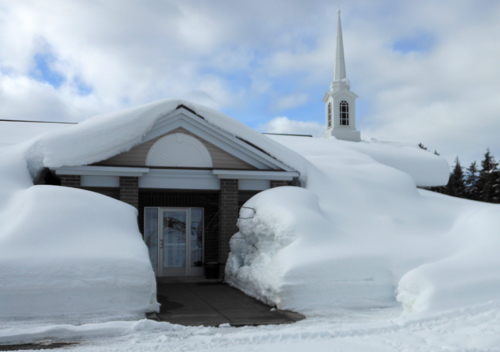
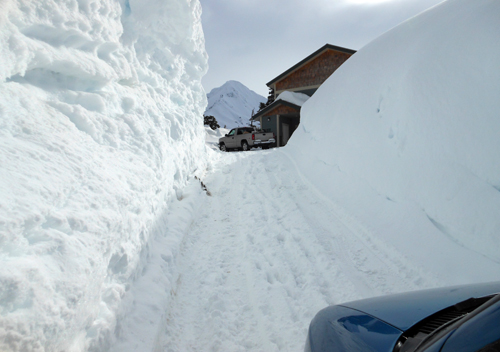
Ample snow - of that I had no doubt whatever. While Prince William Sound is well known for the snowfall it receives each winter, this was a winter that only the oldest residents of Cordova could recall ever having been exceeded. So much snow had fallen so fast that the town needed help for the first time in its history to keep up with the shoveling. National Guard personnel were flown in to help, and the crew of the USCG Sycamore pitched in as well. I would find, on my arrival in town, that there would be plenty left for me to shovel as well.
Alternate Text
Though it had been cleared a few times before, snow lay four feet deep on the finger-float of my slip. Clearing the dock was only a prelude to the work of carefully clearing the decks of Tamara. The plastic shrink-wrap cover that we install each fall to cover the cockpit had survived the enormous snow-load and shed some of the burden. But a solid igloo encased the boat through-out its full length. Two days work were required to clear dock and deck.

It wasn't long after all the shoveling that I was able to set up the stove pipe, commission the diesel stove, and move back aboard. She had wintered well, all things considered. Another week provisioning, topping-up fuel, and struggling with the only winter-capable water tap in the harbor, and the boat and I were ready. I was stiff and sore, but had survived my first physical test.
Alternate Text
Catching the ebb tide, Tamara and I left the next morning. The sky was sealed from horizon to horizon with clouds that were as heavy and gray as lead. Soon snow was flying as thick as smoke, and the northeast wind lanced sharply through the valley from the mountains just beyond town. But I knew that as soon as we'd rounded Salmo Point and turned west down the long inlet, we'd put wind and snow on our stern. The favorable tide would shorten the time to the first anchorage, a place called Comfort Cove, where a spectacular bowl is sculpted from the mountains to the east, and perfect meadows at the head of the bay would offer excellent back-country skiing.

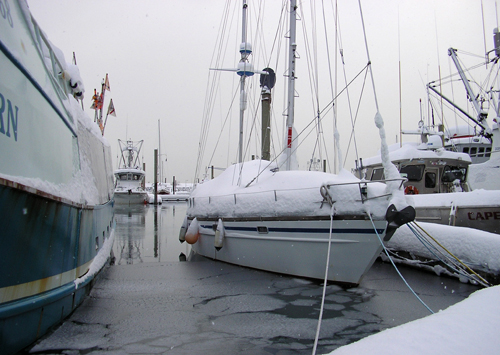
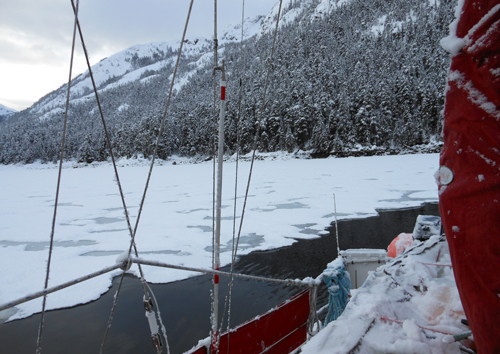
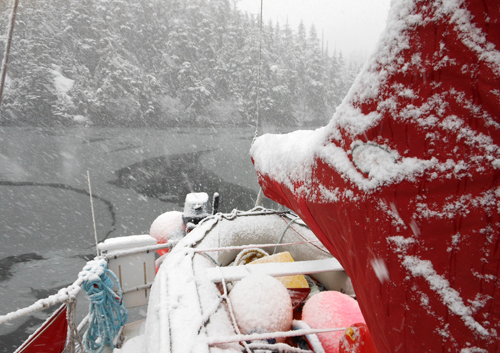
As I turned into the narrow entrance to the cove, the snow-laden northeast wind was as bitter as my disappointment - Comfort Cove was nearly completely frozen over! Frozen over with not just new brash-ice, but heavy shore-fast ice that supported at least a foot of snow. All that remained clear was a small part of the bay just inside the entrance. It would have to do, as time and the failing light would make proceeding on senseless.

I cruised along the ice-edge and concluded that it was securely shore-fast, solid, and not likely to go out with tide or wind, and anchored just off the ice. There could be no ski excursion here, as it was impossible to get anywhere near those alluring meadows, but it would serve as an anchorage.
Alternate Text
Letting go nearly all of the anchor chain, I rove a light line through the chain near the bitter end, tied a shot of floating line to the first with a carrick bend, and finally tied three very small, round floats to the end. Should I be wrong in my judgment that the ice would not go out, I could easily slip the last of the chain. The floating line with the small floats offered scant resistance, and would easily be over-ridden by the ice. Tamara could then go out to sea with the ice, return and retrieve the ground tackle. As a fisherman I'd had to slip anchor like this a couple of times, and I was thankful for lessons born of experience.

Overnight the snow continued. By morning I had more snow to clear from the deck, but also got to enjoy watching a couple of coyotes as they gamboled on the ice futilely chasing ravens, bald eagles circling overhead watching the antics.
Alternate Text
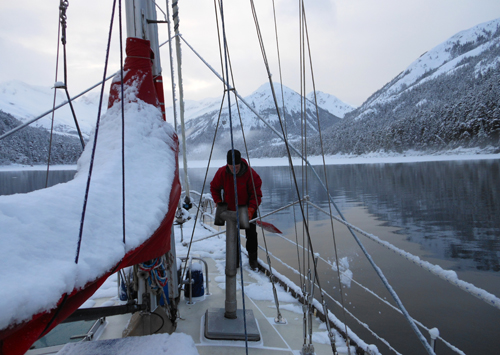
I remained a few days while the snow continued, and new brash-ice began to form from the slush created by the heavy snow falling into the sea. The air temperature dipped to 6 degrees F one morning, and the weather forecast included warnings of heavy freezing spray.
Alternate Text
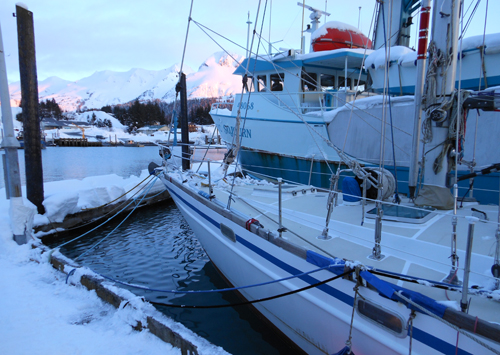
As the sky cleared, I made for Port Chalmers, on Montague Island. Not only are there spectacular mountains with open approaches accessible from the lagoon at the head of the anchorage, but Port Chalmers has a special place in the history of Euro-American exploration of Prince William Sound. George Dixon (1786) and Nathanial Portlock (1787), both of whom had been officers aboard HMS Resolution under James Cook on the Third Voyage of Discovery, had returned to the sound on their own accounts to pursue the maritime fur trade. With knowledge of the anchorage, they both used it to careen their ships, and both felled tall, straight fir trees here for use as spars.

A few years later, in 1791, George Vancouver in HMS Discovery, following up on Cook's work, was baffled by the fact the stumps from the earlier spar-gathering were several feet under water. He was unaware of the common seismic activity in the sound, and didn't understand geologic subsidence. He would have been even more befuddled were he to see those same stumps, by then well brine-pickled, returned to the surface by uplifting during the 1964 Good Friday earthquake.

I knew I couldn't stay long in Port Chalmers - it offers no opportunity for securing lines ashore. Vancouver was literally blown right out of the anchorage by violent williwaws in 1791, loosing his ground tackle. But with a favorable forecast I remained a few days, and was able to get in a good ski tour ashore.

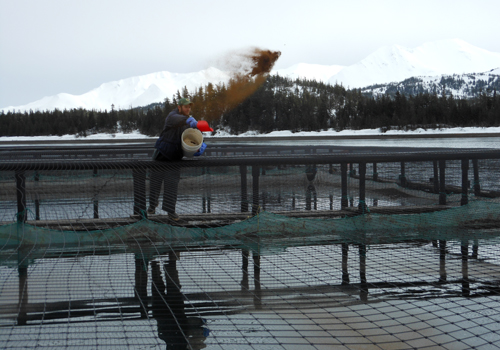
A salmon enhancement effort, funded by assessments on their catch voted in by fishermen, is operated here by the Prince William Sound Aquaculture Corp. Forty million salmon fry are confined to net-pens much of each winter, fed hourly during daylight, and then released in the spring. Having been given a small head start, they stand an increased chance of survival during their years at sea. Then, having been imprinted by the waters of Port Chalmers, they return as spawning adults.
Alternate Text
The PWSAC crew charged with running this salmon head-start program promised to keep a close eye on Tamara. Their boat was well secured by a huge mooring anchor, and the pens by several more. So I could go ashore with confidence, and have ample warning should the weather change. They treated me to dinner aboard as well, and a tour of their operation. It would be the only human interaction of my entire cruise; indeed I would not even see another vessel of any kind. In winter, the sound is wilderness.

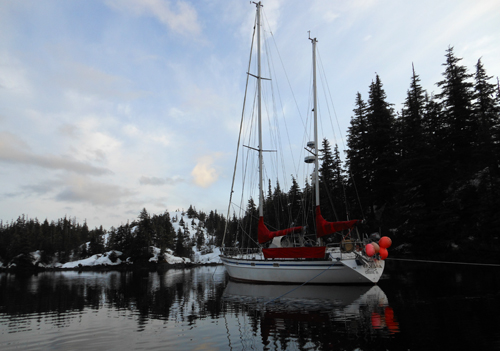
On a day so calm the winter sun glancing off the sea made the water look dull and heavy as mercury, I pushed on from Port Chalmers, knowing such conditions seldom last long at this latitude in winter. I wanted to get up Knight Island Passage to a small land-locked notch in the southwest corner of Squire Island that I knew to be perfectly secure in all conditions. A true hurricane-hole. Though cyclonic hurricanes don't occur in Alaska, hurricane-strength winds are not uncommon. Just the prior fall, Nancy and I were delayed in our journey home by hurricane-strength winds that closed the Port of Valdez and shore-bound the ferry.
Alternate Text
The Squire Island anchorage would let me run a web of lines ashore, and the alpine meadows all around would make great cross-country skiing. Better yet, a friend who had been in the area conducting a fishery survey just a few days before I'd left town, reported that it was ice-free.

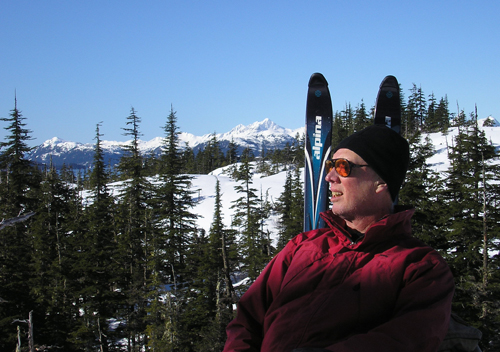
I'd spend a couple of weeks at Squire Island, Tamara secured to trees ashore, enjoying the extraordinarily deep snow laying in the meadows and forest. Completely alone except for the eagles working the thermals of the peaks above, a couple of fat seals, and a few clowning sea-otters.

Occasional new snow, even rain a couple of times, but for the most part a persistent late-winter high pressure system yielded clear, cold, star-filled nights,Venus resplendent. The snow pack, firmed by each night's cold, made fine spring skiing in the warmth of the next day's sun.
Alternate Text
But then, likely because of the security of my moorings at Squire Island, as well as the beautiful, calm days, I broke the vow of caution that I had professed at the outset of the cruise.

Alone, and trying to illustrate the story with photographs, I mounted the camera on a tripod , set it up in the dinghy, and rowed ashore. As if to chastise me for my smugness, the camera and tripod went overboard, just as I reached the beach. I grabbed it frantically, poured the contents of my water bottle over the camera in hopes of some salvation, and though the electronics survived, the lens was ruined. Thankfully the memory chip yielded up my prior efforts, and I still had an older, less sophisticated, camera back on board.

In ensuing days, I took Tamara deep into the mountains themselves to Seven Fathom Hole in Jackpot Bay, where I had to break a bit of thin new ice in order to carve out an anchorage, then on to the small, completely landlocked, but difficult to enter lagoon at Disk Island where I knew there to be broad meadows, frozen lakes, and gentle slopes with stunning views of the peaks to both the north and the west. Eventually we made Bass Harbor on Naked Island, and finally back to Comfort Cove. More than a month since my first attempt, the bay was now ice-free, yet the bountiful snow of this winter still covered the valley and the mountain bowl.

Across Port Gravina, beyond the entrance to the cove, the sun set low and stretched ribbons of light across the bay all the way from the western mountains to the dark slopes of the alpine bowl at the head of the anchorage. The great play-write, Thornton Wilder, wrote that, “When one is at home he dreams of adventure. When one is on an adventure he dreams of home.” I'm not so sure if that's so with me. Sometimes the presence is an enchantment even greater than the absence.

Labels: , , , ,

Friday, October 07, 2011

Reflections - a Look Back

Alternate Text

After some time in the Shumagin Islands and Sand Point, it seemed our break in the weather had finally come. As we headed east towards Kodiak, along the Alaska Peninsula, we were treated to the incredible, though unfortunately rare, views of the mountains to the north. They had been totally obscured on our west bound journey earlier in the summer. Because we were enjoying such good weather, we decided to spend a little bit more time and explore the in-shore routes.

Alternate Text

One of the traditional harbors used by the schooners that plied these waters a hundred years ago in search of cod, halibut and seals is formed by two islands just south of the Alaska Peninsula. In the days of working sailing vessels, harbors that afforded two entrances (as well as exits) were much preferred. In the event of a dramatic wind shift, the boat could escape without being trapped on a lee shore. Kupreanof Harbor, formed by Jacob and Peter Islands, fills this requirement, and has been long considered one of the finest in the region. In addition, being some distance from the very high mountains of the Peninsula, the islands are not as prone to the dangerous katabatic winds, or williwaws, common in the area.

Alternate Text

The passage between the harbor and the mainland is known as Humpback Bay, and, as the name implies, is frequented by large whales. A great number were grazing in the bay as we transited, though as usual were invariabley too far distant for good photographs from the boat.

Alternate Text

Mitrofania Island, Castle Cape, and the volcanic peaks of the Peninsula were in their full glory, the sunshine feeding our souls. This gave us an exceptionally fine passage for Kodiak.

Alternate Text

Kodiak is starting to seem like our second home port, as it’s been a stopover the last three summers. Weather forecasts for crossing the Gulf and our return to Prince William Sound (PWS) were not very favorable upon our arrival, so the decision was made to spend a few days at Long Island near the town, awaiting good conditions and enjoying the sunny, though windy, weather. When a brief weather window appeared to be opening up, we made a quick overnight visit to Kodiak City for fuel and provisions, then headed across the Gulf for the Sound. As it turned out, it proved a good choice since the weather took a major turn for the worse. A series of southeasterly gales, some of hurricane force winds, rolled through the Eastern Gulf of Alaska for the next few weeks.

Alternate Text

Our arrival back in PWS was greeted with another severe gale. One of our favorite anchorages, known locally as the Fox Farm, soon became crowded with salmon seine boats. Included were several friends of Mark’s, awaiting the next fishing opening and taking refuge from the weather. Our plan was to get back to Cordova by the first of September, allowing us several weeks to meander home. PWS offers so many areas to explore, and since the weather was cloudy and rainy we opted to explore the west side of Knight Island and it’s many anchorages. Part of the motivation would be to explore a little, and note where we‘d like to return for a more in-depth visit in the future.

Alternate Text

As often seems to be the case cruising, the day we rounded the north end of the island was one of those days people spend lots of money to see - a beautiful clear day exposing the mountains and glaciers to the north and west. After a frustrating season with little fine weather, it would be our luck that both as we left the Peninsula and the Sound, all that we’d hoped for would be revealed.

Alternate Text

One of our incentives for getting into Cordova sooner than later was to visit with two sailboats that we’d met along the way - Kim and Kirsten on s/y Sol (Danish); and Cam and Marilyn on s/y Makali‘i. Both couples had decided to leave their boats in Cordova while returning to their respective homes for the winter. Kim and Kirsten we had first met in Ushuaia, Argentina, near Cape Horn, at Christmas time, 2006. They have wintered Sol in Puget Sound the last two years and visited us at home a couple of times. Cam and Marilyn, whom we met last year on Kodiak, spent many years in the Pacific and are from Lewiston, ID. Kim and Kirsten met Cam and Marilyn in Hawaii two years ago. These are the sort of cruising networks that develop with more years and miles under the keel. So it was fun to have everyone over for dinner on Tamara before departing for our homes.

Alternate Text

If you remember last year‘s “blog” post, September in PWS was spectacularly beautiful. Not so this year. It would pour rain for four or five days, perhaps give a break in the weather for a day, then return to pouring rain. This of course makes getting outdoor projects completed nearly impossible. Nancy would sneak away whenever it wasn’t raining to get in a brief hike, while Mark’s main concern was getting Tamara ready for winter. This lay-up would include shrink-wrapping the cockpit area, a task that requires there be no wind or rain. A day's respite from the wind and rain enabled us to get Tamara covered just before flying home.

Alternate Text

Cordova is the primary fishing port in the sound, and is one of the leading ports in the country. This season Cordova ranked eighth in the country by volume, and fourth by value. As a consequence, environmental health of PWS is critical to the well being of the town.

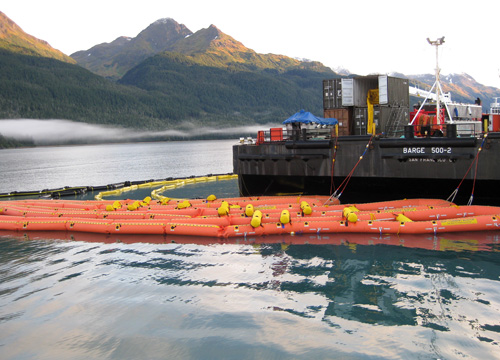
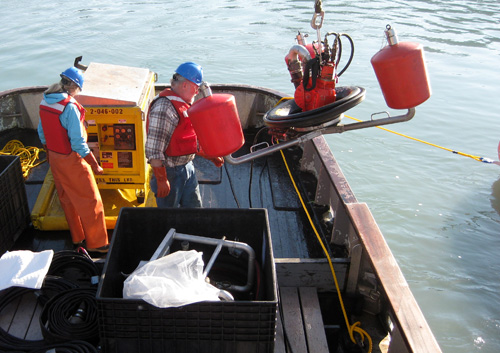
Following the Exxon Valdez oil spill disaster in Prince William Sound in 1989, a complex vessel escort and spill recovery system has emerged. Integral to this system has been the formal training and organization of many of the commercial fishing vessels of the region.

Alternate Text

Every year boats and captains that are contracted to be part of this system must participate in formal annual training and practical drills. This is also true as well for all crew members who want to participate in the system. Boats and crew are paid for both the training and the drills, and for us this can be a nice addition to the cruising kitty.

Alternate Text

Mark first took the training last spring as a crew member on a friend’s boat, and repeated it again this spring. He also participated in a surprise drill for four days.

This Fall, Nancy underwent the training, so she too is now qualified for future drills, as well as an actual cleanup. Her group lucked out - their on the water training day was one of the few calm sunny days in September. With the escort system and the structured response plan the hope is never to have a another spill. However there have been occasional spills, including one caused by the grounding of an escort vessel on Bligh Reef, the same hazard involved in 1989, apparently caused by an inattentive pair of young maritime academy graduates text messaging and playing on computers! The system has been employed for more than just drills.

Alternate Text

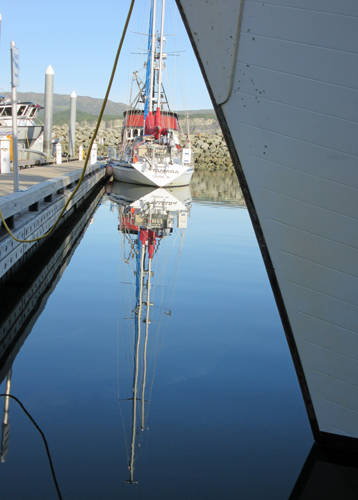
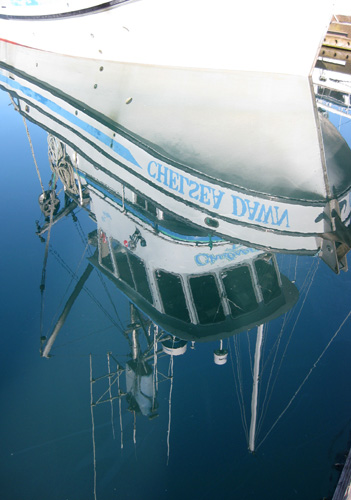
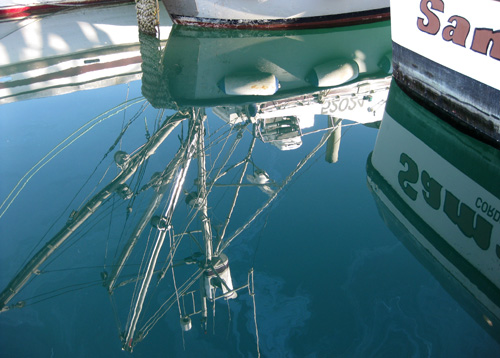
The photographic theme of this posting, “Reflections - A Look Back” comes not only from the wonderful photographic opportunities presented by reflected light, but also because this is where this long voyage all began. It was in the fisheries not only of the Copper River and Prince William Sound, but of all of Alaska far to the Bering Sea that gave us the opportunity for the years of adventure. Not only was a good living afforded by the years in the industry, but those years provided the accumulated experience and expertise that enabled us to undertake such ambitious voyages. Antarctica and Labrador, the Bering Sea and the Alaska Peninsula are not common cruising grounds, but the years and miles under the keel that were earned here, stood us in very good stead there. The prior posting details some of those places and people along our way.

Alternate Text

Future plans? Those are all still only being formulated. Next spring will likely see a major refit on Tamara, the first one of this extent in all the years she’s served us. Included will likely be rebuilding the engine, and other mechanical systems. Better to do it now than after the work becomes yet more difficult for Mark. Other than the refit, we will likely do a slow and easy Prince William Sound pleasure cruise, and possibly a winter ski expedition in the mountainous regions of the sound before the refit.
As usual we also intend a few lecture/slide shows that are presently booked, and will be considering a series of shows “on the road” next winter. Contact us for details.

Alternate Text

Labels: , ,

Friday, September 24, 2010

Prince William Sound

Alternate Text

During the first part first of our Kodiak visit we concentrated our efforts cruising the southeastern coast of the island group. By the middle of July we headed for the northern island group. Our first stop was the native village of Ouzinkie ( population 192) on Spruce Island, home to St. Herman, the first canonized Russian Orthodox saint in North America.

Alternate Text

From Spruce Island, we crossed Marmot Bay to Afognak Island, the second largest island in the Kodiak Archipelago, and anchored in Afognak Bay. A couple we had met on Kodiak told us that there was a good hike along the Afognak River up to Afognak Lake and indicated that there would be lots of Kodiak Bears. We never did see any bears but we saw LOTS of scat on the old logging road that parallels the river. The Afognak Native Cooperation privately owns the island and logs a large section of the island, the effects of which became more noticeable as we entered Izhut Bay. The bay offers great whale watching and has several good anchorages, but most of the area has been logged down to the shore, making hiking impossible, as the thick underbrush that first grows back is impenetrable.

Alternate Text

While anchored in Sopasa Bay, we twice sucked the omnipresent jellyfish into our cooling water intake system, shutting down our small diesel generator. In our ten years on the boat we have only had this happen once before. The one sure way to clear the system - use an air horn to blast out the blockage! But all the bays were full of jellyfish and we were running out of the small air canisters for the horn. Luckily, we did not have another such encounter --until Prince William Sound!

Alternate Text

Seal Bay, on the north coast of Afognak, was very picturesque with only one of it’s many small bays having been logged. There was good hiking along the shores and in the woods and well protected anchorages. Our plan had been to continue onto Shuyak Island, the northern most island, but it had been raining almost daily the last couple weeks and Prince William Sound was beckoning. With a good weather forecast we crossed the north Gulf of Alaska on August 2nd and re-entered Prince William Sound.

Alternate Text

We spent the next two weeks in Western Prince William Sound, stopping in some previously visited anchorages and exploring some new ones. From mid-July to mid-August we had only two days of little or no rain. As soon as we’d see a break in the rain we’d jump in the dinghy and get to shore to walk. And with all the moisture you’d think the mosquitoes would be thick as thieves, but we encountered very few. Perhaps they couldn’t fly with their wings so wet!

Alternate Text

Alternate Text

Towards mid-August the weather started showing signs of improvement and sunny days began to out number rainy days. Fortunately some time remained to continue the cruise before returning to Cordova on September 1st. After all our miles in TAMARA, not a very ambitious season, about 1300 miles in all, but in a still relatively unraveled part of the world. And of course the history, scenery, and adventure of the region make for a wonderful season away from the ordinary.

Alternate Text
Nellie Juan Anchorage, June

Alternate Text

Nellie Juan Anchorage, August

Our return to Cordova was festive again this season. Though not returning after so long and so far as we did a year ago, this season saw one of the finest salmon seasons on record for both the Cordova seine and gillnet fisheries. Coupled with the finally arriving spectacular late summer, the mood all about town was up-beat.

Alternate Text

Alternate Text

The weather this summer had been some of the worst on record. Anchorage reported thirty-two consecutive days of rain, which is very unusual, as that area is generally comparatively dry. Yet the winds were light with no big storms. But summer did finally arrive by mid-August and Prince William Sound enjoyed a month of almost perfect weather and little wind. Everyone was out hiking, berry picking, boating, just enjoying the sunshine after such a bleak summer. And for those crossing the Gulf of Alaska, a notoriously tempestuous area by September, it was smooth sailing. Everyday you’d hear someone say, “How much longer can this last?”, or “This is very unusual for this time of year.” But all good things must come to an end and today, the 24th of September, there’s a storm warning in the Gulf Alaska and a gale in Prince William Sound.

Alternate Text

Alternate Text

Labels: , , , ,

Monday, July 19, 2010

Summer on Kodiak

Alternate Text

The first three weeks of this summer's cruise was devoted to exploring new anchorages in Prince William Sound (PWS) and waiting for the weather to settle down to allow us to cross the frequently tempestuous northern Gulf of Alaska to Kodiak Island. We had spent two days on Kodiak last summer on our way east from the Alaskan Peninsula to PWS and planned on exploring the island group more extensively this summer.

Alternate Text

As we left Cordova to cross over to the western side of the Sound, we were surprised by the amount of snow still lingering in the lower elevations of the mountains. In many anchorages there was still snow on the shore, and the lower valleys and streams remained heavily covered.

Alternate Text

Typically, at this time of the year, the weather in the Sound seems to average three or four days of rain, then a day of partial sunshine before the cycle repeats. This season was no exception. Whenever the sky cleared we would go ashore to hike, if possible, and the rest of the time take excursions in the inflatable swaddled in our foul weather gear.

The two hundred mile crossing to Kodiak was accomplished easily, but without the view of the mountains and glaciers of the Kenai Peninsula often possible en-route, as the cloud cover extended to sea level.

Alternate Text

Kodiak, of course, is the well known major fishing port known throughout the world. But it also is the home of the enormous Kodiak Brown Bear, the world's largest carnivore. In summer they descend the mountain sides from their winter dens, eating mostly the rich, dense grasses on the slopes. Later they beach comb along shore, and when the summer salmon runs begin, they gorge in preparation for the next winter. Much of our cruise would be devoted to watching bears, otters, seals, whales and birds, and the Kodiak islands affords an outdoor theater for animal entertainment.

Alternate Text

Alternate Text

During WWII, Long Island, located a few miles from the town of Kodiak, was completely occupied by the army as a site for coastal gun emplacements. The old roads that crisscrossed the island have grown over but now make great hiking trails. The trails wander through moss covered Sitka Spruce forests, and around small lily covered lakes - very enchanting. At strategic outcrops the remains of the gun emplacements and the barracks that supported them emerge from the mossy green Hobbit forest.

Alternate Text

Alternate Text

We left Long Island to explore the SE coast of the island group, an area not normally visited by pleasure boats.

Alternate Text

Our first anchorage was in Shearwater Bay, located inside Kiliuda Bay, and the site of an old cannery that was destroyed by the tsunami created by the 1964 Alaskan earthquake. The anchorage is very well protected, tucked behind an outcrop of rocks and gravel spits. Every day we explored a different part of the bay, and each time we found the signs of bears (footprints and scat) but no animals. Finally we spotted a bear working the mud flats in a lagoon behind the spit. He watched us for a few minutes then turned around a ran away, snorting as he went.

Alternate Text

Alternate Text

We were visited one day by a family that runs a wilderness lodge further up Kiliuda Bay. They had been out collecting fire wood off the beaches, saw our masts, and stopped to see if we needed anything. We talked with them for about an hour and then they offered us a crab that they had caught that afternoon. As soon as they left we had that crab in the pot for dinner! Excellent!

We continued on towards Old Harbor, the only community on this part of the island. We had hoped to moor in it's small harbor, but on approach we found that the entrance was too shallow, so we abandoned that plan. The weather was such that we couldn't anchor in front of the village so we backtracked to MacDonald Lagoon, an anchorage reached through a narrow break in two shingle spits protecting the lagoon. To our enjoyment, a large bear was in residence in the crook of the lagoon just inshore of our anchorage.

Alternate Text

Alternate Text

On a long beach walk just outside the lagoon, we were—as always—amazed at the quantity of plastic jetsam washed ashore. In just a few meters of beach we collected a substantial pile. But included in this junk was a can of Japanese beer, intact though battered by an apparent lengthy ocean adventure. No English on the label indicated that it wasn't intended for export, but floated in on its own. When we returned to the boat, Mark enjoyed the first cold beer in some time. Bounty of the Sea!!

Alternate Text

Mark has long been interested in the history of whaling, particularly in the Bering Sea and the Western Arctic. In the course of his readings he found a reference to the Port Hobron Whaling Station, which was established in 1915 and operated until 1930. Port Hobron is a small fjord not far from the village of Old Harbor, so we went in search of the station. We were not expecting to find much remaining, and were surprised to see most of the oil tanks and processing machinery still on site, the remains of a whale chaser boat on the beach, and the dilapidated superintendent's house. The site was very much the same as the one we visited in Hawk Harbor, Labrador.

Alternate Text

By the time of World War I there were of course alternatives for whale oil as lighting, but it was still in use for specialized machinery, and was a primary source of glycerin. Glycerin of course is an ingredient in high explosives, and market demand was exceptionally high during the war. The meat and bone were dried and made into cattle feed and fertilizer. The long cylinders visible in the photographs are the remains of steam heated rotary screw driers.

Alternate Text

As one sails west from the town of Kodiak, large trees begin to disappear, and the slopes are covered instead with some alder and cottonwood, and a verdant dense grass cover. Wild flowers of every color are interwoven in the grasses. Nancy spent hours on her knees photographing flowers—now she has to find a good book to find out their names.

Alternate Text

Alternate Text

Labels: , , , ,