Winter Cruise in Prince William Sound
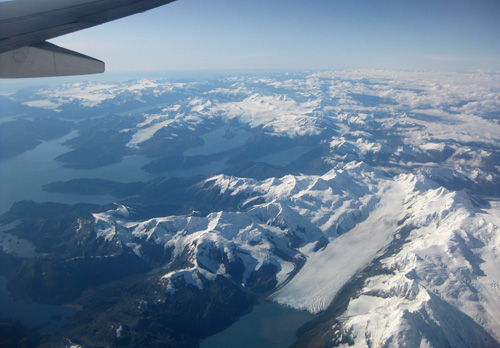
Early in my career as a fisherman, I'd made a week-long passage from Cape Newenham, on the Bering Sea coast, to Cordova in Prince William Sound. It was early spring, just after the sea-ice had finally gone out for the year. Along the way, the volcanic peaks and rugged glaciers of the Alaska Peninsula made me wonder what it would be like to take a boat deep into those fjords and ski the remote slopes. More years of experience taught me, however, that there were really no secure anchorages in that region that would offer adequate protection for a boat while off skiing.
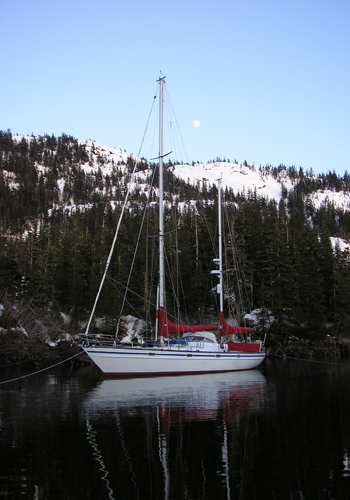
But Prince William Sound was another world altogether. The sound is replete with small, well protected anchorages, many of which afford opportunity to run lines ashore to securely moor a boat. This would be essential, as the mountains and glaciers of the region generate severe, sometimes violent, katabatic winds. It just wouldn't do to be up skiing and have a williwaw blow the yacht aground, or out to sea.
The challenge would be to find secure anchorages that were not frozen over, and this was not always easy or even predictable. Although the sound lies mostly between 60 degrees and 61 degrees north latitude, small bays and sheltered anchorages here generally freeze not solely as a result of extreme cold, but more often due to the quantity of fresh water that flows out atop the seawater. That freshwater varies from season to season and from place to place. Short of chartering an airplane, the only real way to find out would be to go and have a look.
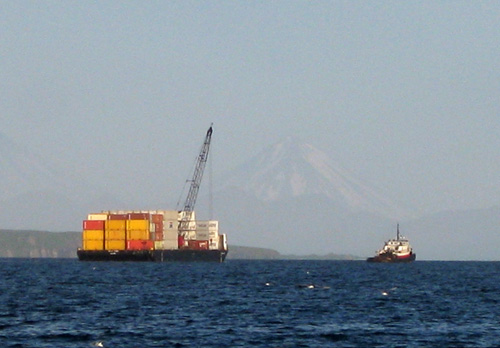
Summer brings hundreds of vessels engaged in one way or another in the salmon fishery, along with cruise ships and more pleasure boats each season. In the winter there is essentially no traffic at all in the sound, save for an occasional tug and barge or ferry. But that's exactly what I was after. I wanted the seclusion of winter, and that would be just what I would get.
Not only would I be far from the assistance possible during the summer, the very fact that it was winter added additional risk. The Coast Guard helicopter based in Cordova each salmon season wasn't even there in winter. Sea water temperature of fifty degrees in summer is dangerous enough, but thirty-seven degrees in winter would be catastrophic were I to go overboard from yacht or dinghy. The greatest risk would be in going ashore. Dinghy trips at that water temperature are inherently dangerous enough, but would be compounded by the risk of being stranded, of injury while skiing, or of avalanche.
Safety would have to trump all other considerations. The usual jack-line would be replaced by a stout line rove chest-high between main and mizzen shrouds. Not only does such a set-up permit a harness tether to be easily clipped on, but it affords greater security to begin with, as it's easy to stay inboard the line as well as use it as an additional hand-hold. And as unusual as it might be, the boarding ladder would always be deployed, even underway, in order that I would have some chance of getting back aboard without assistance.
Shore excursions and ski trips would have their own set of special rules. My rucksack would remain packed at all times with certain essentials. A 10'x12' nylon tarp that could be set up in any number of configurations, nylon twine, and a stout knife capable of cutting spruce boughs for building shelter, fire starter (cotton balls saturated with diesel fuel in a water-tight container), wind and waterproof storm matches, two compressed, vacuum-packed life-raft ration bricks and a tin of corned beef, flares, whistle and a hand-held VHF radio capable of both marine and aircraft frequencies, the antenna unscrewed, packed in a Tupperware container comprised the emergency equipment. Finally, the day's lunch, water bottle, an extra pair of heavy socks, and a thick but light parka filled out the pack.
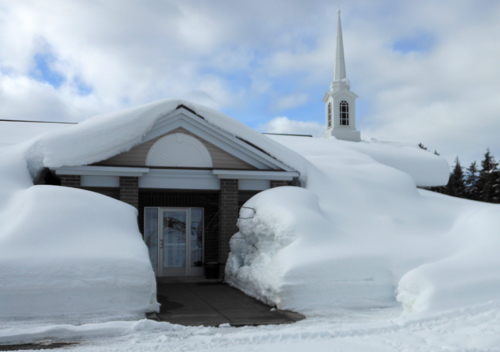
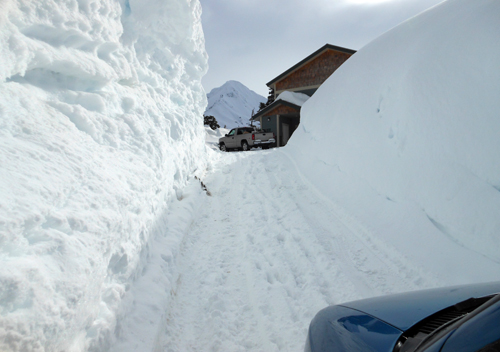
Ample snow - of that I had no doubt whatever. While Prince William Sound is well known for the snowfall it receives each winter, this was a winter that only the oldest residents of Cordova could recall ever having been exceeded. So much snow had fallen so fast that the town needed help for the first time in its history to keep up with the shoveling. National Guard personnel were flown in to help, and the crew of the USCG Sycamore pitched in as well. I would find, on my arrival in town, that there would be plenty left for me to shovel as well.
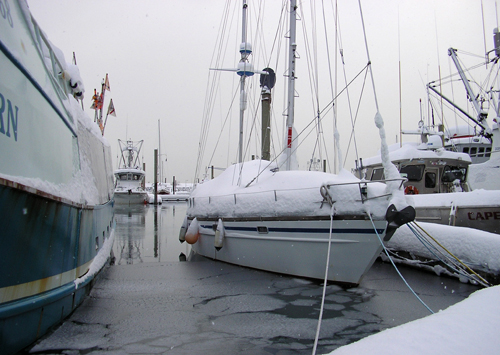
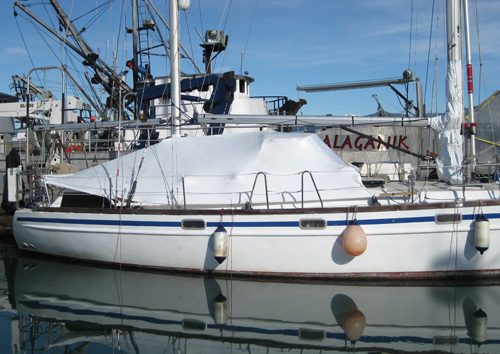
Though it had been cleared a few times before, snow lay four feet deep on the finger-float of my slip. Clearing the dock was only a prelude to the work of carefully clearing the decks of Tamara. The plastic shrink-wrap cover that we install each fall to cover the cockpit had survived the enormous snow-load and shed some of the burden. But a solid igloo encased the boat through-out its full length. Two days work were required to clear dock and deck.
It wasn't long after all the shoveling that I was able to set up the stove pipe, commission the diesel stove, and move back aboard. She had wintered well, all things considered. Another week provisioning, topping-up fuel, and struggling with the only winter-capable water tap in the harbor, and the boat and I were ready. I was stiff and sore, but had survived my first physical test.
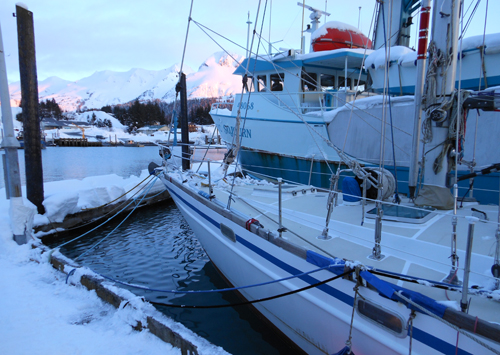
Catching the ebb tide, Tamara and I left the next morning. The sky was sealed from horizon to horizon with clouds that were as heavy and gray as lead. Soon snow was flying as thick as smoke, and the northeast wind lanced sharply through the valley from the mountains just beyond town. But I knew that as soon as we'd rounded Salmo Point and turned west down the long inlet, we'd put wind and snow on our stern. The favorable tide would shorten the time to the first anchorage, a place called Comfort Cove, where a spectacular bowl is sculpted from the mountains to the east, and perfect meadows at the head of the bay would offer excellent back-country skiing.
As I turned into the narrow entrance to the cove, the snow-laden northeast wind was as bitter as my disappointment - Comfort Cove was nearly completely frozen over! Frozen over with not just new brash-ice, but heavy shore-fast ice that supported at least a foot of snow. All that remained clear was a small part of the bay just inside the entrance. It would have to do, as time and the failing light would make proceeding on senseless.
I cruised along the ice-edge and concluded that it was securely shore-fast, solid, and not likely to go out with tide or wind, and anchored just off the ice. There could be no ski excursion here, as it was impossible to get anywhere near those alluring meadows, but it would serve as an anchorage.
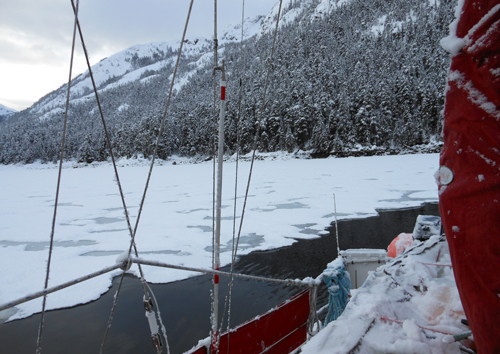
Letting go nearly all of the anchor chain, I rove a light line through the chain near the bitter end, tied a shot of floating line to the first with a carrick bend, and finally tied three very small, round floats to the end. Should I be wrong in my judgment that the ice would not go out, I could easily slip the last of the chain. The floating line with the small floats offered scant resistance, and would easily be over-ridden by the ice. Tamara could then go out to sea with the ice, return and retrieve the ground tackle. As a fisherman I'd had to slip anchor like this a couple of times, and I was thankful for lessons born of experience.
Overnight the snow continued. By morning I had more snow to clear from the deck, but also got to enjoy watching a couple of coyotes as they gamboled on the ice futilely chasing ravens, bald eagles circling overhead watching the antics.
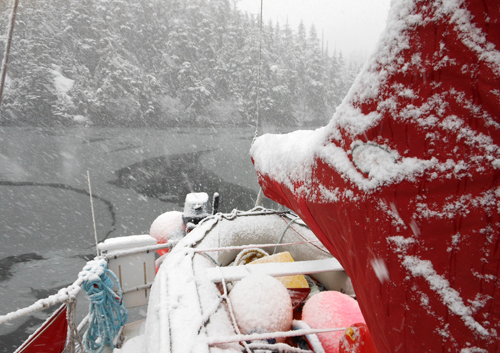
I remained a few days while the snow continued, and new brash-ice began to form from the slush created by the heavy snow falling into the sea. The air temperature dipped to 6 degrees F one morning, and the weather forecast included warnings of heavy freezing spray.
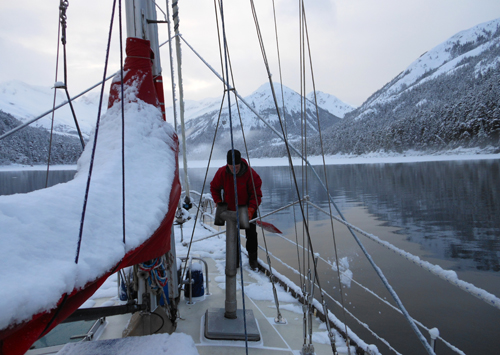
As the sky cleared, I made for Port Chalmers, on Montague Island. Not only are there spectacular mountains with open approaches accessible from the lagoon at the head of the anchorage, but Port Chalmers has a special place in the history of Euro-American exploration of Prince William Sound. George Dixon (1786) and Nathanial Portlock (1787), both of whom had been officers aboard HMS Resolution under James Cook on the Third Voyage of Discovery, had returned to the sound on their own accounts to pursue the maritime fur trade. With knowledge of the anchorage, they both used it to careen their ships, and both felled tall, straight fir trees here for use as spars.
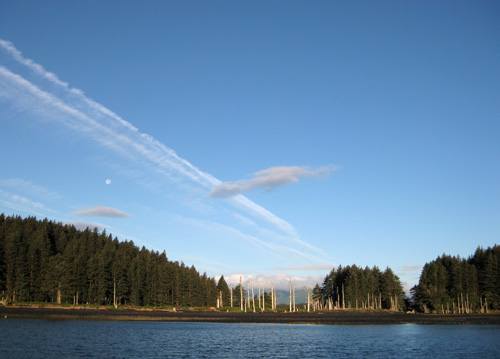
A few years later, in 1791, George Vancouver in HMS Discovery, following up on Cook's work, was baffled by the fact the stumps from the earlier spar-gathering were several feet under water. He was unaware of the common seismic activity in the sound, and didn't understand geologic subsidence. He would have been even more befuddled were he to see those same stumps, by then well brine-pickled, returned to the surface by uplifting during the 1964 Good Friday earthquake.
I knew I couldn't stay long in Port Chalmers - it offers no opportunity for securing lines ashore. Vancouver was literally blown right out of the anchorage by violent williwaws in 1791, loosing his ground tackle. But with a favorable forecast I remained a few days, and was able to get in a good ski tour ashore.
A salmon enhancement effort, funded by assessments on their catch voted in by fishermen, is operated here by the Prince William Sound Aquaculture Corp. Forty million salmon fry are confined to net-pens much of each winter, fed hourly during daylight, and then released in the spring. Having been given a small head start, they stand an increased chance of survival during their years at sea. Then, having been imprinted by the waters of Port Chalmers, they return as spawning adults.
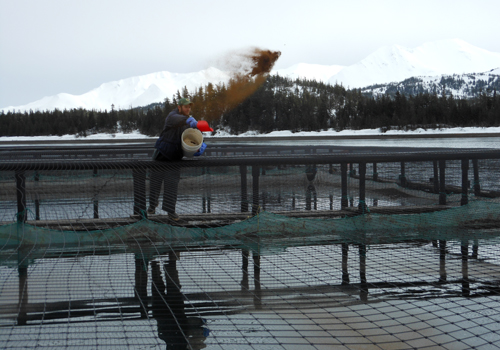
The PWSAC crew charged with running this salmon head-start program promised to keep a close eye on Tamara. Their boat was well secured by a huge mooring anchor, and the pens by several more. So I could go ashore with confidence, and have ample warning should the weather change. They treated me to dinner aboard as well, and a tour of their operation. It would be the only human interaction of my entire cruise; indeed I would not even see another vessel of any kind. In winter, the sound is wilderness.
On a day so calm the winter sun glancing off the sea made the water look dull and heavy as mercury, I pushed on from Port Chalmers, knowing such conditions seldom last long at this latitude in winter. I wanted to get up Knight Island Passage to a small land-locked notch in the southwest corner of Squire Island that I knew to be perfectly secure in all conditions. A true hurricane-hole. Though cyclonic hurricanes don't occur in Alaska, hurricane-strength winds are not uncommon. Just the prior fall, Nancy and I were delayed in our journey home by hurricane-strength winds that closed the Port of Valdez and shore-bound the ferry.
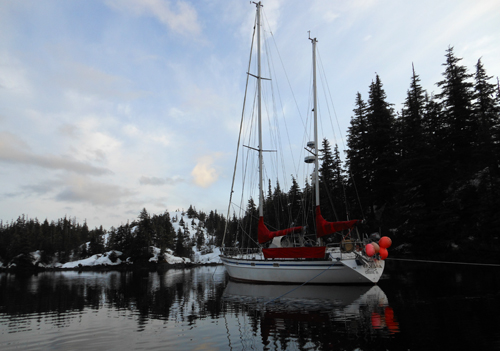
The Squire Island anchorage would let me run a web of lines ashore, and the alpine meadows all around would make great cross-country skiing. Better yet, a friend who had been in the area conducting a fishery survey just a few days before I'd left town, reported that it was ice-free.
I'd spend a couple of weeks at Squire Island, Tamara secured to trees ashore, enjoying the extraordinarily deep snow laying in the meadows and forest. Completely alone except for the eagles working the thermals of the peaks above, a couple of fat seals, and a few clowning sea-otters.
Occasional new snow, even rain a couple of times, but for the most part a persistent late-winter high pressure system yielded clear, cold, star-filled nights,Venus resplendent. The snow pack, firmed by each night's cold, made fine spring skiing in the warmth of the next day's sun.
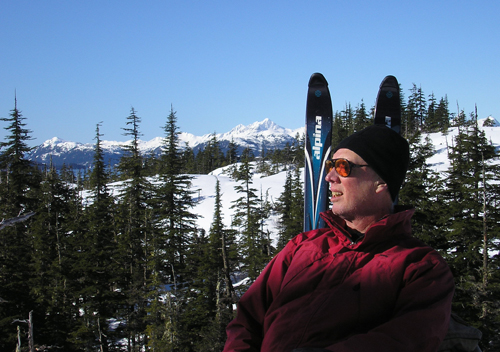
But then, likely because of the security of my moorings at Squire Island, as well as the beautiful, calm days, I broke the vow of caution that I had professed at the outset of the cruise.
Alone, and trying to illustrate the story with photographs, I mounted the camera on a tripod , set it up in the dinghy, and rowed ashore. As if to chastise me for my smugness, the camera and tripod went overboard, just as I reached the beach. I grabbed it frantically, poured the contents of my water bottle over the camera in hopes of some salvation, and though the electronics survived, the lens was ruined. Thankfully the memory chip yielded up my prior efforts, and I still had an older, less sophisticated, camera back on board.
In ensuing days, I took Tamara deep into the mountains themselves to Seven Fathom Hole in Jackpot Bay, where I had to break a bit of thin new ice in order to carve out an anchorage, then on to the small, completely landlocked, but difficult to enter lagoon at Disk Island where I knew there to be broad meadows, frozen lakes, and gentle slopes with stunning views of the peaks to both the north and the west. Eventually we made Bass Harbor on Naked Island, and finally back to Comfort Cove. More than a month since my first attempt, the bay was now ice-free, yet the bountiful snow of this winter still covered the valley and the mountain bowl.
Across Port Gravina, beyond the entrance to the cove, the sun set low and stretched ribbons of light across the bay all the way from the western mountains to the dark slopes of the alpine bowl at the head of the anchorage. The great play-write, Thornton Wilder, wrote that, “When one is at home he dreams of adventure. When one is on an adventure he dreams of home.” I'm not so sure if that's so with me. Sometimes the presence is an enchantment even greater than the absence.
But Prince William Sound was another world altogether. The sound is replete with small, well protected anchorages, many of which afford opportunity to run lines ashore to securely moor a boat. This would be essential, as the mountains and glaciers of the region generate severe, sometimes violent, katabatic winds. It just wouldn't do to be up skiing and have a williwaw blow the yacht aground, or out to sea.
The challenge would be to find secure anchorages that were not frozen over, and this was not always easy or even predictable. Although the sound lies mostly between 60 degrees and 61 degrees north latitude, small bays and sheltered anchorages here generally freeze not solely as a result of extreme cold, but more often due to the quantity of fresh water that flows out atop the seawater. That freshwater varies from season to season and from place to place. Short of chartering an airplane, the only real way to find out would be to go and have a look.
Summer brings hundreds of vessels engaged in one way or another in the salmon fishery, along with cruise ships and more pleasure boats each season. In the winter there is essentially no traffic at all in the sound, save for an occasional tug and barge or ferry. But that's exactly what I was after. I wanted the seclusion of winter, and that would be just what I would get.
Not only would I be far from the assistance possible during the summer, the very fact that it was winter added additional risk. The Coast Guard helicopter based in Cordova each salmon season wasn't even there in winter. Sea water temperature of fifty degrees in summer is dangerous enough, but thirty-seven degrees in winter would be catastrophic were I to go overboard from yacht or dinghy. The greatest risk would be in going ashore. Dinghy trips at that water temperature are inherently dangerous enough, but would be compounded by the risk of being stranded, of injury while skiing, or of avalanche.
Safety would have to trump all other considerations. The usual jack-line would be replaced by a stout line rove chest-high between main and mizzen shrouds. Not only does such a set-up permit a harness tether to be easily clipped on, but it affords greater security to begin with, as it's easy to stay inboard the line as well as use it as an additional hand-hold. And as unusual as it might be, the boarding ladder would always be deployed, even underway, in order that I would have some chance of getting back aboard without assistance.
Shore excursions and ski trips would have their own set of special rules. My rucksack would remain packed at all times with certain essentials. A 10'x12' nylon tarp that could be set up in any number of configurations, nylon twine, and a stout knife capable of cutting spruce boughs for building shelter, fire starter (cotton balls saturated with diesel fuel in a water-tight container), wind and waterproof storm matches, two compressed, vacuum-packed life-raft ration bricks and a tin of corned beef, flares, whistle and a hand-held VHF radio capable of both marine and aircraft frequencies, the antenna unscrewed, packed in a Tupperware container comprised the emergency equipment. Finally, the day's lunch, water bottle, an extra pair of heavy socks, and a thick but light parka filled out the pack.
Ample snow - of that I had no doubt whatever. While Prince William Sound is well known for the snowfall it receives each winter, this was a winter that only the oldest residents of Cordova could recall ever having been exceeded. So much snow had fallen so fast that the town needed help for the first time in its history to keep up with the shoveling. National Guard personnel were flown in to help, and the crew of the USCG Sycamore pitched in as well. I would find, on my arrival in town, that there would be plenty left for me to shovel as well.
Though it had been cleared a few times before, snow lay four feet deep on the finger-float of my slip. Clearing the dock was only a prelude to the work of carefully clearing the decks of Tamara. The plastic shrink-wrap cover that we install each fall to cover the cockpit had survived the enormous snow-load and shed some of the burden. But a solid igloo encased the boat through-out its full length. Two days work were required to clear dock and deck.
It wasn't long after all the shoveling that I was able to set up the stove pipe, commission the diesel stove, and move back aboard. She had wintered well, all things considered. Another week provisioning, topping-up fuel, and struggling with the only winter-capable water tap in the harbor, and the boat and I were ready. I was stiff and sore, but had survived my first physical test.
Catching the ebb tide, Tamara and I left the next morning. The sky was sealed from horizon to horizon with clouds that were as heavy and gray as lead. Soon snow was flying as thick as smoke, and the northeast wind lanced sharply through the valley from the mountains just beyond town. But I knew that as soon as we'd rounded Salmo Point and turned west down the long inlet, we'd put wind and snow on our stern. The favorable tide would shorten the time to the first anchorage, a place called Comfort Cove, where a spectacular bowl is sculpted from the mountains to the east, and perfect meadows at the head of the bay would offer excellent back-country skiing.
As I turned into the narrow entrance to the cove, the snow-laden northeast wind was as bitter as my disappointment - Comfort Cove was nearly completely frozen over! Frozen over with not just new brash-ice, but heavy shore-fast ice that supported at least a foot of snow. All that remained clear was a small part of the bay just inside the entrance. It would have to do, as time and the failing light would make proceeding on senseless.
I cruised along the ice-edge and concluded that it was securely shore-fast, solid, and not likely to go out with tide or wind, and anchored just off the ice. There could be no ski excursion here, as it was impossible to get anywhere near those alluring meadows, but it would serve as an anchorage.
Letting go nearly all of the anchor chain, I rove a light line through the chain near the bitter end, tied a shot of floating line to the first with a carrick bend, and finally tied three very small, round floats to the end. Should I be wrong in my judgment that the ice would not go out, I could easily slip the last of the chain. The floating line with the small floats offered scant resistance, and would easily be over-ridden by the ice. Tamara could then go out to sea with the ice, return and retrieve the ground tackle. As a fisherman I'd had to slip anchor like this a couple of times, and I was thankful for lessons born of experience.
Overnight the snow continued. By morning I had more snow to clear from the deck, but also got to enjoy watching a couple of coyotes as they gamboled on the ice futilely chasing ravens, bald eagles circling overhead watching the antics.
I remained a few days while the snow continued, and new brash-ice began to form from the slush created by the heavy snow falling into the sea. The air temperature dipped to 6 degrees F one morning, and the weather forecast included warnings of heavy freezing spray.
As the sky cleared, I made for Port Chalmers, on Montague Island. Not only are there spectacular mountains with open approaches accessible from the lagoon at the head of the anchorage, but Port Chalmers has a special place in the history of Euro-American exploration of Prince William Sound. George Dixon (1786) and Nathanial Portlock (1787), both of whom had been officers aboard HMS Resolution under James Cook on the Third Voyage of Discovery, had returned to the sound on their own accounts to pursue the maritime fur trade. With knowledge of the anchorage, they both used it to careen their ships, and both felled tall, straight fir trees here for use as spars.
A few years later, in 1791, George Vancouver in HMS Discovery, following up on Cook's work, was baffled by the fact the stumps from the earlier spar-gathering were several feet under water. He was unaware of the common seismic activity in the sound, and didn't understand geologic subsidence. He would have been even more befuddled were he to see those same stumps, by then well brine-pickled, returned to the surface by uplifting during the 1964 Good Friday earthquake.
I knew I couldn't stay long in Port Chalmers - it offers no opportunity for securing lines ashore. Vancouver was literally blown right out of the anchorage by violent williwaws in 1791, loosing his ground tackle. But with a favorable forecast I remained a few days, and was able to get in a good ski tour ashore.
A salmon enhancement effort, funded by assessments on their catch voted in by fishermen, is operated here by the Prince William Sound Aquaculture Corp. Forty million salmon fry are confined to net-pens much of each winter, fed hourly during daylight, and then released in the spring. Having been given a small head start, they stand an increased chance of survival during their years at sea. Then, having been imprinted by the waters of Port Chalmers, they return as spawning adults.
The PWSAC crew charged with running this salmon head-start program promised to keep a close eye on Tamara. Their boat was well secured by a huge mooring anchor, and the pens by several more. So I could go ashore with confidence, and have ample warning should the weather change. They treated me to dinner aboard as well, and a tour of their operation. It would be the only human interaction of my entire cruise; indeed I would not even see another vessel of any kind. In winter, the sound is wilderness.
On a day so calm the winter sun glancing off the sea made the water look dull and heavy as mercury, I pushed on from Port Chalmers, knowing such conditions seldom last long at this latitude in winter. I wanted to get up Knight Island Passage to a small land-locked notch in the southwest corner of Squire Island that I knew to be perfectly secure in all conditions. A true hurricane-hole. Though cyclonic hurricanes don't occur in Alaska, hurricane-strength winds are not uncommon. Just the prior fall, Nancy and I were delayed in our journey home by hurricane-strength winds that closed the Port of Valdez and shore-bound the ferry.
The Squire Island anchorage would let me run a web of lines ashore, and the alpine meadows all around would make great cross-country skiing. Better yet, a friend who had been in the area conducting a fishery survey just a few days before I'd left town, reported that it was ice-free.
I'd spend a couple of weeks at Squire Island, Tamara secured to trees ashore, enjoying the extraordinarily deep snow laying in the meadows and forest. Completely alone except for the eagles working the thermals of the peaks above, a couple of fat seals, and a few clowning sea-otters.
Occasional new snow, even rain a couple of times, but for the most part a persistent late-winter high pressure system yielded clear, cold, star-filled nights,Venus resplendent. The snow pack, firmed by each night's cold, made fine spring skiing in the warmth of the next day's sun.
But then, likely because of the security of my moorings at Squire Island, as well as the beautiful, calm days, I broke the vow of caution that I had professed at the outset of the cruise.
Alone, and trying to illustrate the story with photographs, I mounted the camera on a tripod , set it up in the dinghy, and rowed ashore. As if to chastise me for my smugness, the camera and tripod went overboard, just as I reached the beach. I grabbed it frantically, poured the contents of my water bottle over the camera in hopes of some salvation, and though the electronics survived, the lens was ruined. Thankfully the memory chip yielded up my prior efforts, and I still had an older, less sophisticated, camera back on board.
In ensuing days, I took Tamara deep into the mountains themselves to Seven Fathom Hole in Jackpot Bay, where I had to break a bit of thin new ice in order to carve out an anchorage, then on to the small, completely landlocked, but difficult to enter lagoon at Disk Island where I knew there to be broad meadows, frozen lakes, and gentle slopes with stunning views of the peaks to both the north and the west. Eventually we made Bass Harbor on Naked Island, and finally back to Comfort Cove. More than a month since my first attempt, the bay was now ice-free, yet the bountiful snow of this winter still covered the valley and the mountain bowl.
Across Port Gravina, beyond the entrance to the cove, the sun set low and stretched ribbons of light across the bay all the way from the western mountains to the dark slopes of the alpine bowl at the head of the anchorage. The great play-write, Thornton Wilder, wrote that, “When one is at home he dreams of adventure. When one is on an adventure he dreams of home.” I'm not so sure if that's so with me. Sometimes the presence is an enchantment even greater than the absence.
Labels: Comfort Cove, Cordova, Port Chalmers, Prince William Sound, Squire Island
posted by Editor at 2:09 PM
0 comments