Saturday, July 30, 2005

About The s/v Tamara
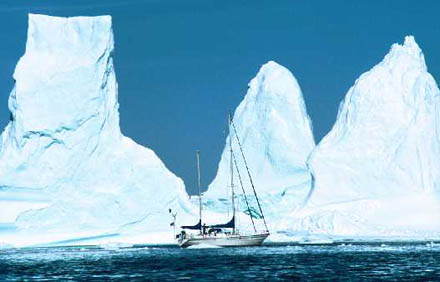
Many of you have asked for technical details on Tamara, particularly those of you who are Boat People, both yachties and fishermen. So here go more details than you probably really cared to have: Tamara was built in Sweden in 1989 of steel. The design is a Langedrag 441, by Rolf Modigh. She strongly resembles a Halberg Rassy 46, but of steel. A center cockpit, double headsail ketch, her length is 43.87 feet, beam 12.8 feet, draft 6.2 feet, waterline length 36.75 feet. She displaces 15 tons. Main engine is a 90hp. Volvo TMD-30A diesel, generator a 6Kw Mase/Rugerini. She tanks 250 gallons fuel, for a range under power of about 1,100 nautical miles, and 200 gallons water. This tankage gives her very a very extended range. Her underbody is very contemporary--shallow forefoot, fin keel, skag hung rudder, large four bladed wheel. She carries both headsails on Selden Furlex roller furling gear, but both main and mizzen sails reef conventionally. She carries four anchors, all chain rode, an electric windlass, and several hundred feet of heavy nylon line for mooring ashore, as well as supplemental anchor rode. Given Mark's long Alaska fisherman experience, and preoccupation with things mechanical, Tamara has a complete workshop in what was originally the port side stateroom, an extensive spare parts inventory, about half a ton of hand and power tools, and various goops and compounds intended to repair most anything. Materials and hardware of every description complete the engineering department's inventory.

Tamara is heavily insulated with sprayed in place foam, and well heated by a Sig-Mar diesel fueled stove, and hot water "bus heater" that scavenges heat from the engine when motoring. Her welded aluminum dodger provides an enclosed helm station, and is heated from below.

Tamara is equipped with an electronics package more in keeping with the workboats of Mark's experience. She carries two hardwired GPS receivers, as well as a hand held unit for back up, dinghy and life raft use. Her communications equipment includes an HF Single Side Band transceiver, two hardwired VHF radios; two hand held VHF radios, and a 2 Meter VHF radio capable of aircraft frequencies. Entertainment and information radios include two AM/FM receivers, and an all-band short wave receiver. Dual station autopilot controls, Radar, two fathometers, wind instruments, and a computer based raster and vector chart plotting system complete her navigation equipment.

About Nancy and Mark

After a career working boats in high latitudes, I suppose most of us would sail south for our retirement. But I never could get enough of that subtle light. I'm still unable to explain it to those not fortunate to have seen for themselves. The same can be said of the Aurora Borealis, the incomparable power of the ice as summer finally sets the rivers flowing once again, the nearly frantic urgency of summer as the birds return and fish push up those same rivers to regenerate their species. The explosion of flowers and berries, held close to the ground to savor summer's sun, as though they somehow know the equinox will soon return the gales that foretell the coming snows of winter. So when the opportunity came to sell our modern ninety-one footer and close out a twenty-one year career in the fisheries of the Gulf of Alaska and Bering Sea, it just seemed natural that Nancy and I would make our first extended cruise to the North.

Nancy spent most of her adult life planning for the next adventure. It started when her family moved to Japan in 1964 while she was in high school. At the time, being only 15 yrs old, she was not convinced of the great opportunity presented to her. She just wanted to go home to California. In 1966 her family returned to the US via Russian (old Soviet Union), Scandinavia and Britain. The experience left a big impression on Nancy and she has been on the move ever since. In 1969 she spent a year traveling from Europe overland through Turkey, Iran, Afghanistan and Pakistan to India and Nepal. On the return trip she spent 3 months on a kibbutz in Israel. Over the years her travels have taken me back to India and Nepal, Sri Lanka, Burma (Myanmar), Thailand, Malaysia, Indonesia, Japan, New Zealand, French Polynesia, Peru, Mexico and North Africa.

Nancy's love of the outdoors and hiking fueled her interest in geology and in 1985, after returning to college, graduated from the University of Washington with a BS in geology. Though she's never worked in the field, she views the world through the eyes of a geologist and naturalist.

There were a few complications however. The offer for the workboat had been unexpected, and had come just before Christmas. The deal came together so quickly that there had been little time to fully consider what would come next. As Mark had sold his job, they had better not waste time realizing the very long held dream of cruising those higher latitudes. It certainly didn't feel like it when Mark departed Prince William Sound for the Gulf of Alaska on a near zero January night to deliver the boat to Vancouver, B.C., but spring was not long off. It just wouldn't due to waste the first summer of his early retirement, but the problem was they owned only a twenty-six foot trailerable, unsuited to extensive cruising.

First they had to find, buy and commission the right boat for work in the arctic, find a new home for the horse and cats, close up their house in Port Townsend, WA, and drive a van load of boat gear across the country to Fort Lauderdale. A tall order in such short time, but not much different from what Mark had to do every spring all those seasons before. This time they would be driving the load of boat gear south, to Florida, instead of north to Alaska--the snow on the roads would be in Montana instead of the Yukon. The logistical and planning experience of those seasons paid great dividends, and by mid-April Tamara, their newly acquired Swedish built 44' steel ketch was bound north for "the Labrador."

Greetings From The Azores!!!

Positions: 07/30/05, 39 28.312N, 31 43.230W, 0600 UTC 07/30/05, 39 22.900N, 31 09.900W, 1250 UTC; Anchor Porto das Lajes.

Greetings from the Azores!!! What a wonderful place - very mellow, charming and hot. Motored into the harbor at Porto das Lajes, Island of Flores at 12:45 pm after another night of very light SE winds. There are about 8 other boats on anchor. Took awhile to get the dinghy together but finally got to shore about 3:00 pm.

Did the walk all over the village to find customs and immigration - got immigration taken care of but still haven't found the person for customs. No one seems that concerned.

Found a cash machine so finally got some Euros and had dinner at Paula's.

Tomorrow there's a festival in the next village, supposedly a half hour walk away, that we want to attend.

We'll watch the weather reports and head for Horta in a few days. But for now we're grooving on the whole scene.

Don't know why more people don't experience this place.

All Time Is Relative

If you have noticed the date and time’s for the position readings you know that they can be up to two days old. That’s not really the case and we will attempt to correct it at this time (Pun intended.)

The editor of this blog, John Krill, set the time reference for Pacific Daylight. We've changed that to more closely reflect the time zone of the svTamara.

Nancy and Mark have been sending in their messages in the early evening (Universal Time.) We usually post them the following morning – Pacific Time. We think that is an eight-hour difference. By changing the blog time to reflect Universal Time (UTC) will hopefully give the messages a more real time feel. We will also try to post the messages in the evening instead of the following morning.

Note: After posting this message we noticed that all the messages now show the UTC time. Interesting.

Editor: John Krill

Arrive At Flores Island Tomorrow

Positions: 07/28/05, 40 24.794N, 33 40.563W, 0600 UTC; 07/28/05, 40 01.179N, 32 47.862W, 1817 UTC

Winds continue to be light out of the SE and we've been motoring all day (and have been since yesterday morning). Looks like we'll be motoring the rest of the way. Should arrive the island of Flores tomorrow afternoon. Have seen a few dolphins but no whales and no birds. Skies have been clear, warm and slightly humid. Lazy day.

Thursday, July 28, 2005

Hove-to Last Night - Strong Winds

Positions: 07/27/05, 41 03.893N, 35 11.252W, 1000 UTC; 07/27/05, 40 42.523N, 34 24.597W, 2015 UTC

Hove-to last night as winds were strong out of the SE and the seas were building. We were tired and wanted an uneventful night. Got underway again late this morning, winds light out of the SE. Motoring all day. Beautiful day.

Wednesday, July 27, 2005

Looking Forward To Showers

Positions: 07/27/05, 41 28.421N, 36 12.546W, 0600 UTC: 07/27/05, 41 01.032N, 35 31.448W, 1800 UTC

Winds increased last night so we shorten sails and rode it out. Winds finally calmed down about 9:00 am this morning. They've now come around to the SSE, the direction we are headed. 220 miles to the Azores.

Looking forward to showers and a meal out.

Azores In 3 Days

Positions: 07/26/05, 42 18.835N, 38 51.088W, 0530 UTC; 07/26/05, 41 53.645N. 37 33.700W, 1800 UTC

Winds out of the NNE at 20k. Clear sky, warm. Expect to be in the Azores in 3 days.

Tuesday, July 26, 2005

Shearwaters Land In Cockpit

Position 42 31.916N, 39 55.503W, 07/25/05, 1820 UTC

Winds 10K out of SSE. Easy sail all day. Hot and muggy. Mark had 4 shearwaters land in the cockpit last night, attracted to a light he was using to read. He had to pick each one up and help them off the boat.

Monday, July 25, 2005

Weather Map

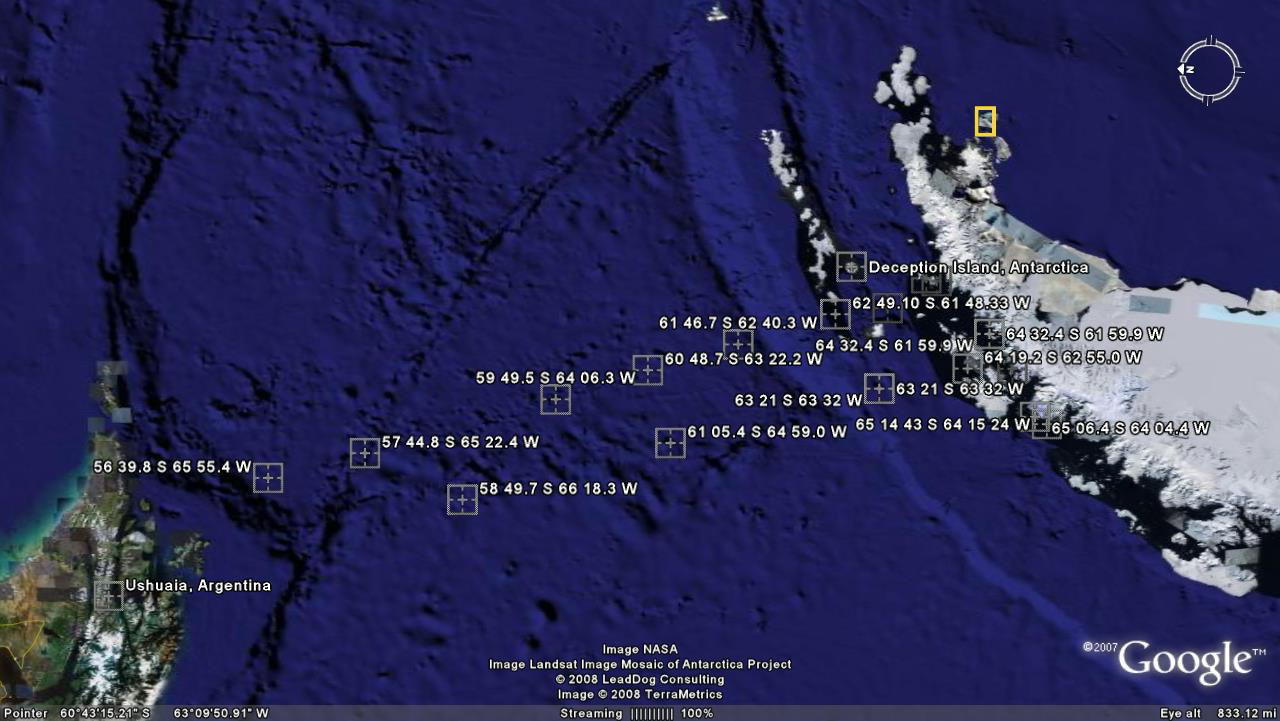
We've added the OceanWeather map of the North Atlantic. Besides showing weather conditions it's also the only map we could find with coordinates included. Now you can map the location of the svTamara.

Sail Mail

This is the free e-mail service being used by the svTamara while at sea.

Their web site states:

The SailMail Association is a non-profit association of yacht owners that operates and maintains a network of private coast stations in the Maritime Mobile Radio Service. The Association provides radioprinter (e.g. Internet email) communications for its members on a cooperative basis, in order to meet the private business and operational needs of the members' yachts.

Warm, overcast skies, visibility 5 miles

svTamara: 07/24/05, 43 08.767N, 41 57.270W, 1815 UTC: 07/25/05, 42 43.062N, 41 06.911W, 0530 UTC

Warm, overcast skies, visibility about 5 miles. Winds out of the SE. Warm and muggy.

Sunday, July 24, 2005

Passed the half-way point to the Azores

Tamara: 07/24/05, 43 34.316N, 42 42.666W, 0530 UTC

07/23/05, 44 07.053N, 44 18.157W, 0520 UTC
07/23/05, 43 53.741N, 43 29.979W, 1750 UTC

Winds have been light from the NW, sailing downwind averaging 3-4k. Good visibility, some clouds, warm. Beautiful morning. We've passed the half-way point to the Azores. It's all downhill from here.

The hardest part about cruising is dealing with the motion of the boat while trying to prepare a meal. The direction and strength of the winds, and the sea state all combine to create a motion. Some days trying to prepare a meal is a real effort and should probably be a sport. Having at least 4 arms (or 6) would definitely be helpful so when you open a cabinet to try and get something out that's behind something else, the door in flopping, and something on the counter you thought was secure decides to take off, and you need to grab something to keep you from ending up somewhere else, the more arms the better. So the last 24 hours we've sailing downwind in light air and it's been pleasant in that cooking hasn't been such a chore.

Nancy & Mark